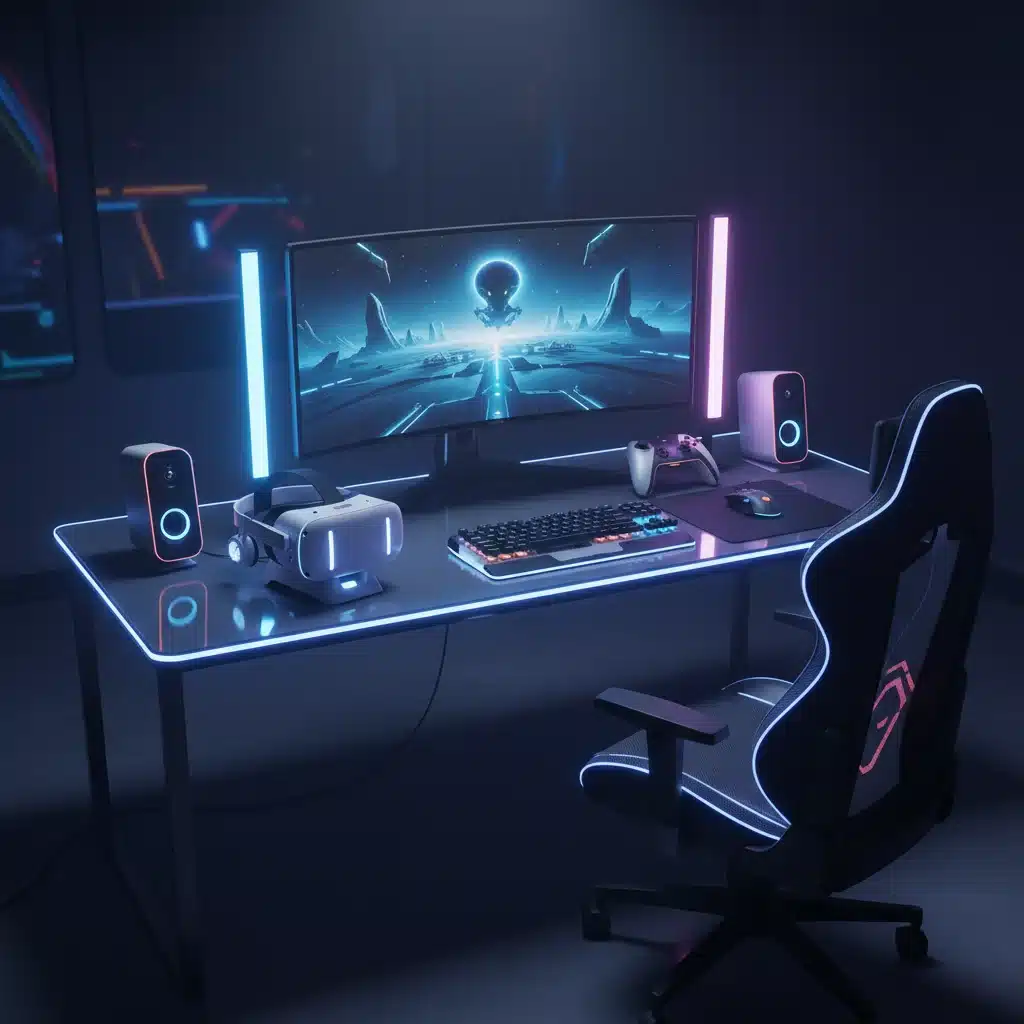
Critical Analysis: Are These 5 New Gaming Gadgets Worth the Investment in 2026 for U.S. Gamers?
The gaming world is an ever-evolving landscape, a digital frontier constantly pushed by innovation and technological ambition. Every year, we witness a deluge of new devices, promising to revolutionize our gameplay, enhance our immersion, and elevate our competitive edge. As we hurtle towards 2026, the buzz around a new wave of 2026 gaming gadgets is palpable, especially for U.S. gamers who are always at the forefront of adopting new tech. But in a market saturated with hype and exorbitant price tags, a critical question arises: are these new gaming gadgets truly worth the investment? This comprehensive analysis will dissect five of the most anticipated 2026 gaming gadgets, scrutinizing their features, potential impact, and ultimately, their value proposition for the discerning U.S. consumer.
Investing in gaming technology isn’t just about owning the latest and greatest; it’s about making informed decisions that align with your gaming habits, budget, and long-term expectations. The promise of enhanced realism, unparalleled performance, and groundbreaking interactivity often comes with a significant financial outlay. Our goal here is to cut through the marketing jargon and provide a clear, unbiased perspective on whether these upcoming 2026 gaming gadgets deserve a spot in your setup or if they are merely fleeting fads. We’ll consider factors like innovation, practicality, durability, and, crucially, the actual improvement they bring to the gaming experience. For U.S. gamers, who often face unique market dynamics and pricing strategies, this critical evaluation is more important than ever.
Anuncios
The Landscape of 2026 Gaming Gadgets: What to Expect
Before diving into specific products, it’s essential to understand the broader trends shaping the 2026 gaming gadgets market. We’re seeing a strong emphasis on hyper-realistic graphics, more immersive virtual and augmented reality experiences, advanced haptic feedback systems, and AI-driven enhancements. Connectivity and seamless integration across multiple platforms are also becoming paramount. These trends suggest a future where gaming isn’t just about what’s on your screen, but how deeply you can interact with and feel the digital world. The competition among manufacturers is fierce, leading to rapid advancements but also a risk of rushed or unpolished releases. U.S. gamers, known for their high expectations and willingness to embrace innovation, will be key drivers in determining the success of these new technologies.
The economic climate and supply chain challenges could also play a significant role in the availability and pricing of these 2026 gaming gadgets. Consumers will need to weigh the immediate gratification of early adoption against the potential for price drops and software refinements in later iterations. Furthermore, the compatibility of these new gadgets with existing gaming ecosystems (PCs, consoles, cloud platforms) will be a major concern. A groundbreaking piece of hardware is only as good as its ability to integrate seamlessly into a gamer’s current setup. This holistic view is crucial for any U.S. gamer considering a significant investment in the next generation of gaming tech.
Anuncios
Gadget 1: The ‘Omni-Sense’ Haptic Feedback Suit
The Promise: Unprecedented Immersion
One of the most talked-about 2026 gaming gadgets is the ‘Omni-Sense’ Haptic Feedback Suit. This full-body suit promises to deliver an unprecedented level of immersion by translating in-game actions into physical sensations. Imagine feeling the impact of a bullet, the rumble of an explosion, or the subtle brush of wind as you traverse a virtual landscape. Utilizing an array of micro-actuators and advanced pressure sensors, the Omni-Sense aims to bridge the gap between the digital and physical realms, making virtual reality (VR) and even traditional screen-based gaming far more visceral. Early prototypes suggest a remarkable ability to differentiate between various types of impacts and environmental textures, offering a nuanced haptic experience previously unimaginable. For U.S. gamers craving the ultimate escapism, this could be a game-changer.
The Reality Check: Price, Practicality, and Content
While the concept is undeniably exciting, the ‘Omni-Sense’ Haptic Feedback Suit faces significant hurdles. Firstly, the projected price point is rumored to be in the premium range, potentially making it an exclusive item for a niche market. For the average U.S. gamer, this might represent a prohibitive investment, especially considering that it’s an accessory rather than a core gaming platform. Secondly, practicality is a concern. A full-body suit, while immersive, could be cumbersome to put on and take off, requiring dedicated space and potentially leading to discomfort during extended gaming sessions. Will gamers truly want to don a suit every time they play? Finally, and perhaps most critically, content support will be paramount. Without widespread developer adoption and integration into popular titles, the suit’s capabilities will remain largely untapped. Early adopters might find themselves with a cutting-edge piece of hardware that has limited application. The success of this 2026 gaming gadget hinges on its ability to transcend novelty and become a truly integral part of the gaming ecosystem.
Gadget 2: ‘Quantum Display’ Hyper-Refresh Monitors
The Promise: Visual Fidelity Beyond Imagination
For PC gamers, visual fidelity and responsiveness are king. The ‘Quantum Display’ Hyper-Refresh Monitors are among the most anticipated 2026 gaming gadgets aiming to push these boundaries. These monitors boast refresh rates exceeding 1000Hz, combined with sub-0.1ms response times and next-generation Quantum Dot OLED (QD-OLED) technology, delivering unparalleled color accuracy, contrast, and motion clarity. Imagine a gaming experience so fluid and responsive that input lag becomes an archaic concept, and every frame is rendered with breathtaking precision. For competitive U.S. gamers, who often measure success in milliseconds, such a display could offer a significant advantage, potentially redefining what’s possible in esports. The visual leap promised by these displays is genuinely tantalizing, offering a glimpse into the future of gaming aesthetics.
The Reality Check: Diminishing Returns and Hardware Demands
While the ‘Quantum Display’ monitors sound revolutionary, the practical benefits for many U.S. gamers might be subject to diminishing returns. Most human eyes struggle to perceive differences beyond 240Hz, and even professional esports players often find 360Hz to be more than sufficient. A 1000Hz refresh rate, while technically impressive, might offer negligible real-world advantages for the majority of users. Furthermore, driving such a display at its full potential will require an extraordinarily powerful graphics card, likely exceeding the capabilities of even high-end systems available in 2026. This means a significant additional investment in a top-tier GPU, pushing the overall cost of this upgrade far higher. The question then becomes: is the marginal visual improvement worth the substantial financial outlay and the need for a complete system overhaul? For many, the answer might be no, making this one of the more niche 2026 gaming gadgets.

Gadget 3: ‘Neural-Link’ Gaming Headset
The Promise: Mind-Bending Control and Bio-Feedback
Perhaps the most ambitious of the 2026 gaming gadgets, the ‘Neural-Link’ Gaming Headset aims to revolutionize input methods by integrating brain-computer interface (BCI) technology. This headset promises to allow gamers to control certain in-game actions, navigate menus, or even influence character emotions purely through thought. Beyond control, it also offers advanced bio-feedback, monitoring stress levels, focus, and emotional states to dynamically adjust game difficulty or provide personalized training insights. Imagine intuitively casting a spell with a thought or having a game adapt to your mental fatigue. For U.S. gamers seeking a deeper, more intuitive connection with their virtual worlds, the Neural-Link offers a glimpse into a sci-fi future becoming reality.
The Reality Check: Ethical Concerns, Latency, and Accessibility
The ‘Neural-Link’ Gaming Headset, while exciting, is fraught with ethical considerations and practical challenges. The idea of direct brain-computer interaction raises privacy concerns regarding mental data collection and potential misuse. Furthermore, the technology itself is still in its infancy. Achieving reliable, low-latency thought-to-action translation in a gaming context is an immense technical hurdle. Early BCI devices often suffer from high latency, requiring significant user training, and are susceptible to interference. The learning curve for effectively utilizing such a device could be steep, potentially alienating casual U.S. gamers. Accessibility is another factor; will this technology be adaptable for all cognitive profiles? The ‘Neural-Link’ might be one of the most intriguing 2026 gaming gadgets, but its widespread adoption depends heavily on overcoming these complex technical and ethical barriers.
Gadget 4: ‘Adaptive AI’ Companion Console
The Promise: Personalized Gaming Experience
The ‘Adaptive AI’ Companion Console is a unique entry among the 2026 gaming gadgets, not as a primary gaming platform, but as an intelligent assistant designed to enhance and personalize your gaming experience. This standalone device, powered by advanced machine learning, analyzes your playstyle, preferences, and even emotional responses to recommend games, optimize settings, provide real-time strategic advice, and even generate personalized in-game content (like quests or challenges). It learns from your habits across all your gaming platforms, offering a truly tailored experience. For U.S. gamers who feel overwhelmed by the sheer volume of content or who seek a more curated journey, this AI companion could be an invaluable tool, transforming how we discover and interact with games.
The Reality Check: Data Privacy and Over-Automation
The ‘Adaptive AI’ Companion Console’s strength lies in its ability to collect and process vast amounts of user data. This immediately raises significant data privacy concerns for U.S. gamers. How will this data be stored, used, and protected? Transparency and user control over personal data will be critical for its acceptance. Furthermore, there’s a fine line between helpful assistance and over-automation. Will an AI that constantly suggests the ‘optimal’ path or generates ‘perfect’ content diminish the joy of discovery, challenge, and organic gameplay? Some gamers might prefer to forge their own path, free from algorithmic influence. The success of this 2026 gaming gadget will depend on finding the right balance between personalization and respecting player autonomy, ensuring it augments, rather than dictates, the gaming experience.

Gadget 5: ‘Modular Core’ Gaming PC
The Promise: Future-Proofing and Customization
The ‘Modular Core’ Gaming PC concept is one of the most practical and appealing 2026 gaming gadgets for many U.S. gamers. Moving away from traditional fixed motherboards and cases, this system features a highly standardized, easily interchangeable component architecture. Think of it as a gaming PC built like a Lego set, where the CPU, GPU, RAM, storage, and even power supply are all housed in hot-swappable, universal modules. This design promises unprecedented ease of upgrades, maintenance, and customization, allowing gamers to future-proof their systems and adapt to evolving hardware standards without replacing the entire rig. For U.S. gamers who value longevity, flexibility, and a degree of DIY involvement, this could represent a significant shift in how we approach PC ownership.
The Reality Check: Industry Adoption and Initial Cost
While the concept of a ‘Modular Core’ Gaming PC is highly attractive, its success hinges entirely on widespread industry adoption and standardization. Without major manufacturers (Intel, AMD, Nvidia, etc.) agreeing on universal module standards, the system would remain proprietary and limited. Convincing these giants to abandon their established ecosystems for a new, open standard is a monumental challenge. Furthermore, the initial cost of such a modular system might be higher than traditional PCs due to the specialized engineering and potentially lower economies of scale in the early stages. If the system remains niche, the cost of individual modules could also remain elevated, negating some of the long-term savings. For this to truly become a revolutionary 2026 gaming gadget, it requires a collaborative effort across the entire PC hardware industry, which history suggests is a difficult feat.
The Verdict: Are These 2026 Gaming Gadgets Worth It for U.S. Gamers?
After a critical examination of these five highly anticipated 2026 gaming gadgets, it’s clear that the answer to whether they are worth the investment is nuanced and depends heavily on individual circumstances and priorities. There’s no one-size-fits-all answer, but we can offer some general guidance for U.S. gamers.
- The ‘Omni-Sense’ Haptic Feedback Suit: For hardcore VR enthusiasts with disposable income and a dedicated gaming space, this could offer an unparalleled level of immersion. However, for the average gamer, the high cost, potential discomfort, and reliance on game support make it a luxury item rather than a necessity. Wait for broader adoption and price drops.
- ‘Quantum Display’ Hyper-Refresh Monitors: These are for the absolute elite competitive gamers and visual purists who demand every possible edge and have the accompanying top-tier PC hardware. For most U.S. gamers, current high-refresh-rate monitors (144Hz-240Hz) already provide an excellent experience, and the additional cost for diminishing returns isn’t justifiable.
- ‘Neural-Link’ Gaming Headset: This is the most experimental of the bunch. While the potential is revolutionary, the technology is still nascent, and ethical concerns are significant. This is a gadget for early adopters and researchers, not for mainstream U.S. gamers looking for reliable, immediate improvements. Proceed with extreme caution and manage expectations.
- ‘Adaptive AI’ Companion Console: This gadget holds considerable promise for enhancing discoverability and personalization, especially for gamers who appreciate curated experiences. The key will be transparency in data usage and ensuring it truly enhances, rather than detracts from, the gaming journey. This could be a solid investment if handled correctly by developers, offering a unique utility that other 2026 gaming gadgets don’t.
- ‘Modular Core’ Gaming PC: This is arguably the most practical and impactful innovation for the long-term health of PC gaming, offering genuine future-proofing. If industry standardization occurs, this could be a highly worthwhile investment for U.S. gamers who want flexibility and longevity from their hardware. Keep a close eye on industry partnerships and initial pricing.
Final Thoughts on 2026 Gaming Gadgets and Your Investment
The year 2026 promises to be an exciting time for gaming technology, with a range of innovative 2026 gaming gadgets poised to enter the market. As U.S. gamers, our role is to approach these advancements with a blend of enthusiasm and critical skepticism. Not every shiny new piece of tech will be a worthwhile investment, and many will likely fall short of their ambitious promises. Prioritize gadgets that offer tangible improvements to your specific gaming habits, align with your budget, and have a clear path to widespread adoption and content support.
Before making any pre-orders or significant purchases, wait for independent reviews, community feedback, and a clear understanding of the real-world performance and integration of these devices. The most valuable investment is often not in the earliest, most expensive iteration, but in the refined, more accessible versions that follow. By staying informed and discerning, U.S. gamers can navigate the exciting, yet often overwhelming, landscape of new 2026 gaming gadgets and ensure their hard-earned money is spent wisely on experiences that truly elevate their passion.
The future of gaming is bright, and the innovations coming our way are truly exciting. However, smart consumerism dictates that we look beyond the marketing hype and focus on genuine value. As we look towards 2026, let’s continue to champion innovation while also demanding products that deliver on their promises and truly enhance the gaming experience for everyone.